|
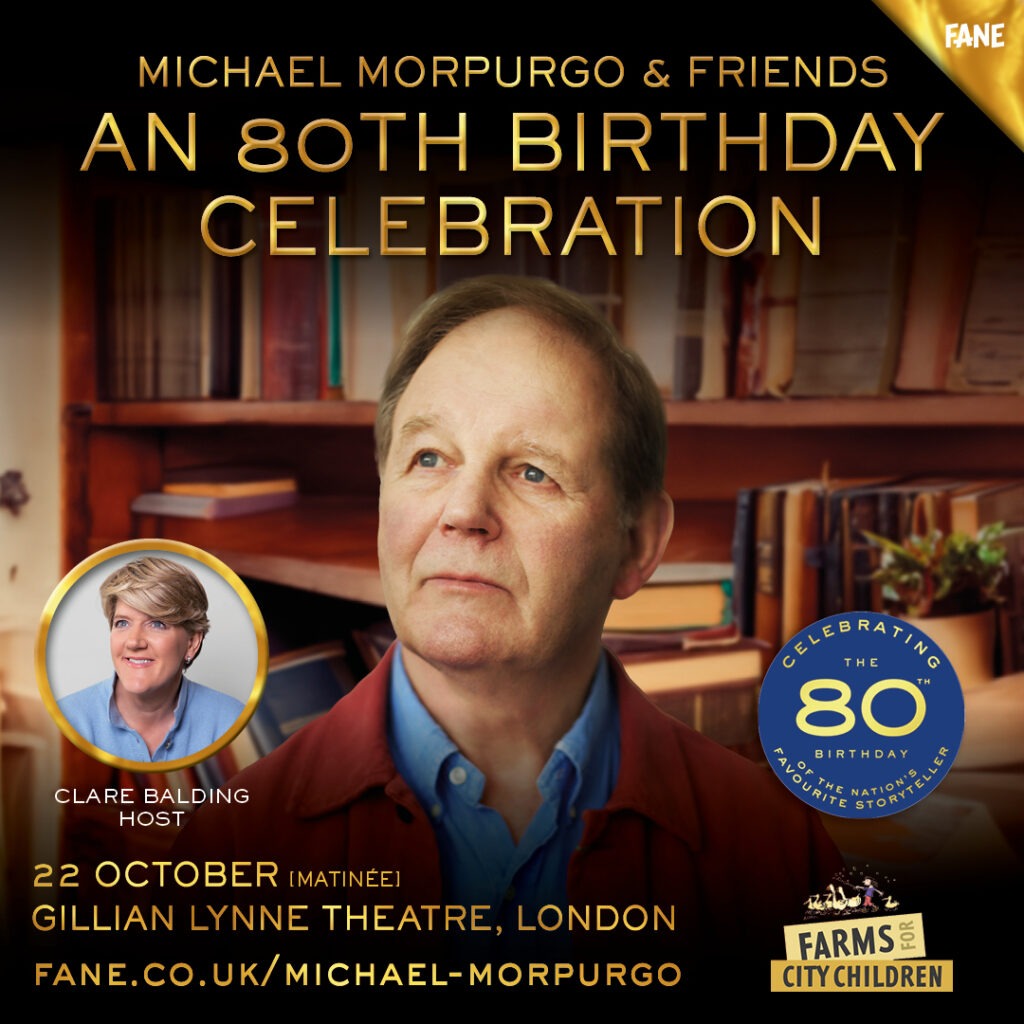
Michael Morpurgo, was the third Children’s Laureate for the UK from 2003-2005. Although there are Poets Laureate in the USA and Canada, for example, the position of Children’s Laureate, is, I think, particular to the UK. The first English Poet Laureate was Ben Johnson appointed in 1619 during the reign of King Charles the Second. The duties until 1843 included responding to state occasions by writing appropriate poetry, since then there have been no official poetic duties although a stipend accompanies the office. The term ‘Laureate’ means to crown with laurels: one who is worthy of special distinction or honour: and with particular reference to a writer, one worthy of the Muses’ crown. The website for the Children’s Laureate makes it clear that: ‘the appointment of a Children’s Laureate recognises and highlights the importance of exceptional children’s authors in creating the readers of tomorrow.’
A rightly celebrated award winning author, Michael Morpurgo has written over 90 titles for children, for young readers and beyond. In addition Michael and his wife also set up and run ‘Farms for City Children’ which comprises three farms, where city children are invited to experience at first hand a relationship with the natural world, and particularly closeness with and caring for animals. This is an approach and attitude clearly reflected in Michael’s writing for children. The valuable work of the Morpurgo husband and wife team was recognised by the award of MBEs in 1999. Michael also writes poetry, plays for children, screenplays and libretto; in all, a wide ranging talented writer, who is fully in touch with the contemporary worlds of childhood. One of the strengths evident in his work is the captivating power of the storyteller, for he creates worlds within his books that live within the imaginations and the sensual experiences of his readers – worlds which exist within the texts and also relate to realities beyond the printed page. His stories not only entrance through the literary expertise he employs, they also extend the experiences of his readers.
Interestingly, when one considers his novels there are indications of patterns in terms of subject matter, genre and narrative structure, that is, how the work is put together. The First and Second World Wars arise as the setting for a number of his novels, for example, amongst others, The Butterfly Lion (1996), War Horse (1982), and Private Peaceful (2003) set in World War One and Kensuke’s Kingdom (1999) and Billy The Kid (2000) in World War Two. The question arises as to why a contemporary author might still be so interested in wars which ended eighty seven and sixty years ago respectively, and why these particular conflicts, since they have sadly been not the only ones within the generational memory Morpurgo covers as he was born in 1943. Furthermore, it is striking that there is a continuing high contemporary consciousness of these two wars in Britain, for example, a good deal of television programming time is devoted to these subjects, and this has been so over the course of my viewing lifetime, which accords with that of Michael Morpurgo, since we are of a similar age. There is a consciousness of these two wars which is built into the national awareness and also arises from a desire to know more – for television depends upon viewing figures, and therefore is an indicator of the predicted areas of interest in the populace.
The First and Second World Wars produced clearly marked boundaries in British social history. Following both wars there was considerable social and cultural change. Following World War One the previous social hierarchies of the aristocracy and the working classes were dislocated. The beliefs in patriotism and heroism came into question when men returned from a war that saw the reduction of humanity and ideals to a seemingly senseless destruction of a generation in the trenches and on the battlefields of France. The high ideals of heroism founded in the nineteenth century in Muscular Christianity and propounded by writers such as Thomas Hughes in Tom Brown’s Schooldays (1857), and G.A. Henty in his tales of imperialism and conquest, could no longer remain inviolable. One might say that the consciousness of the working classes had been irretrievably altered, that is, the model of ‘heroism’ for the ordinary man was no longer of high ideals, - of Dulce Et Decorum Est, when so many had died for reasons they did not understand in situations beyond their control. Michael Morpurgo takes these settings from history where hope, ideals and belief in humanity could seemingly be destroyed, and writes eloquent stories which do not shrink from the awfulness of realities. He demonstrates that even in the most difficult of circumstances there is an interconnectedness which goes beyond class and nationality; that humanity can cross boundaries in circumstances where in the words of Robert Burns ‘Man’s inhumanity to man makes countless thousands mourn’.
Within The Butterfly Lion, War Horse, Kensuko’s Kingdom and Billy The Kid, which have been taken as exemplars, Morpurgo employs two narrative strategies: a relationship between the old and the young and a relationship with an animal. In The Butterfly Lion, Kensuko’s Kingdom and Billy The Kid old meet young and the events of lives set in wartime are related and shared with the young. A young boy in The Butterfly Lion listens to the memories of an old lady recounting the life story of her husband, who was brought up South Africa, which was then under British colonial rule. As a boy her husband had saved a white lion cub, which he later had to relinquish, finally rescuing the adult lion from a French circus when on active duty in World War One, and bringing him back to England to be cared for by himself and his wife. The death of the lion from old age, brings on a deep sense of loss and depression in the now old man. His solution is to carve the shape of the lion into the white chalk of the hillside; his body is laid to rest, whilst his white image is fused with the gentleness of a peaceful landscape. In the summertime blue butterflies settle on the warmed chalk, giving the form of the lion a shimmering blue beauty, a regenerated life each year. The underlying narrative is one of union across boundaries: old and young; human and animal; co-operation across national boundaries under extreme circumstances, finalising in a sense of resolution and peace.
Kensuko’s Kingdom is the meeting of a Japanese soldier and an English boy. The soldier has been stranded on an island since World War Two, not realising that the war had ended. The story explores how each has to come to an understanding in a new world where values have to be re-examined. Hatred derived of patriotism has to be overcome by the soldier, whilst the boy is given insight into the adult mind driven by ideology and duty. What they both find is the meeting of humanity which goes beyond cultural and national division.
In Billy The Kid a war veteran tells a young boy of his foot-balling exploits and experiences during wartime – again union across division and finding commonality across the generations, which is the determination of the writer to communicate to the child reader. Repeatedly, yet with variation, Morpurgo employs the strategies of the meeting of old and young, the sage and the innocent; communication and coming to understanding between different cultures and nationalities which are politically against each other: the microcosm of the ordinary person caught up in the macrocosmic politics of war. His work demonstrates the crossing of boundaries through story.
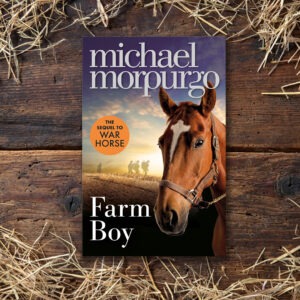
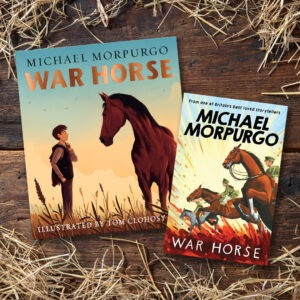
War Horse combines a number of these modes. Written through the focaliser of a horse taken to the battlefields of France during World War I as part of a cavalry regiment, Morpurgo can thus employ the narrative voice as an observer of the human condition, from the position of an innocent consciousness caught up in the conflict, yet powerless to alter his condition. The following extract is set in France on a battlefield in ‘no man’s land’. The horse is unable to traverse the coils of barbed wire: an animal caught in a space between enemy lines, he draws the attention and sympathy from opposing sides providing a meeting of men rather than soldiers. A German soldier advances from one side, a British soldier from the other. Morpurgo does not nominate the nationality of the soldiers, instead describing them as men, one dressed in a grey uniform, the other in khaki. They are clothed in the garb of duty and patriotism, however, beneath the outer trappings which they wear for their country are men who understand animals; each extends a sympathy and humanity to the trapped and suffering animal. Men and horse equally imprisoned by circumstances not of their making and beyond their control. In No Man’s Land, at least for a short time, the men can find a common ground upon which to meet for this stretch of scarred earth technically belongs to neither side. They can find a commonality of understanding, despite language barriers.
The question is, who should take the horse, a problem symbolising the territories at the centre of the conflict. Various suggestions are proposed: by the British soldier, that of King Solomon who would have divided a baby between two disputing mothers with the stroke of a sword – an untenable solution in this case. The German advocates the convention of claiming by first arrival referring to a sense of fair play equated with the game of cricket, thus using an analogy which he expects his English foe to understand. The response from his khaki clad opponent is a retort drawing deeply from the defence of his Welsh pride.
‘Cricket! Cricket!’ said the young man. ‘Who’s ever heard of that barbarous game in Wales? That’s a game for the rotten English. Rugby, that’s my game, and that’s not a game. That’s a religion that is – where I come from.’
(War Horse 131)
Beneath the British uniform is a man who is antagonistic to the English; one identity cloaks another. As there is no initial solution apparent, the Welshman reflects:
‘We could have settled all this peaceful like, Jerry – the war I mean – and I’d be back in my valley and you’d be back in yours. Still, not your fault I don’t suppose. Nor mine either come to that.’ (War Horse, 131)
Thy finally and amicably decide ownership on the toss of a coin.
‘The horse is yours’ (said the German) ‘Take good care of him, my friend.’ And he picked up the rope again and handed it to the Welshman. As he did so he held out his other hand in a gesture of friendship and reconciliation, a smile lighting his worn face. ‘In and hour, maybe, or two,’ he said. ‘We will be trying our best again each other to kill. God only knows why we do it, and I think maybe he has forgotten why. Goodbye Welshman. We have shown them, haven’t we? We have shown them that any problem can be solved between people if only they can trust each other. That is all it needs, no?’
(War Horse, 133)
Repeatedly Michael Morpurgo’s stories tell of a heroism where the protagonists overcome hardship, separation and difficulties enforced upon them by others or circumstances beyond their control. The characters are stoical and enduring as the soldiers in the extract. The soldiers finally had no solutions to overturn the decisions of their masters, as neither could the horse change his situation, they simply had to be and to hope for better times. What they could do, in a small way, was to make a better future by emplacing trust one in the other to care for the horse as far as they could.
Private Peaceful (2003) explores the trust between brothers. Brought up in a rural community prior to the First World War, with their widowed mother working for the local landowner, the Colonel, the two Peaceful boys have a close relationship, but one which is also subliminally threatened by the love they both have for the same young woman, a childhood friend. Morpurgo sets his story within the historical context of pre-War Britain, where rural working class freedom and pride has to negotiate with the restrictions of limited education and working opportunities, which are bounded and controlled by the demands and conventions of a dominant landed gentry. The Peaceful family, despite their name, are not subservient. In addition to the dramas of the battlefield, the family, headed by their mother, must fight to maintain their sense of ‘self’ and not to be swamped by the power of their landlord. This is a domestic drama and one of the experiences of young men who volunteered to fight for their country and are then caught in the inhumanity of an horrific war.
The power of storytelling is enhanced by the narrative form. The reader enters into the voice and mind of the younger brother who ‘writes’ as it were a live journal for his readers, telling his story. The novel begins:
They’ve gone now, and I’m alone at last. I have the whole night ahead of me, and I won’t waste a single moment of it. I shan’t sleep it anyway. I won’t dream it away either. I mustn’t, because every moment of it will be far too precious.
I want to try to remember everything, just as it was, just as it happened. I’ve had nearly eighteen years of yesterdays and tomorrows, and tonight I must remember as many of them as I can.
(Private Peaceful 7)
The weight of time is powerful, and reverberates throughout the novel, setting up puzzles and possible pathways for predicting what might happen, or has happened, which emphasizes the growing drama. The teenagers leave their rural home, full of pride, idealism, patriotism and duty, to join the conflict locked armies in the trenches. Shortly they become disillusioned marionettes caught dangling on the rack of war; entrenched both physically and mentally. They are adolescents caught in the world of men. Charlie, the elder brother, has always demonstrated a strong sense of self; caring for his younger sibling, Tommo, and battling against the control executed by class dominance. The potential division between the brothers over the love of a woman, who becomes Charlie’s wife, is overcome by the strong and deeply loving relationship they hold between them; the younger brother sublimating his potential jealousy and desires, yet able to express such through the intimate relationship he has with the reader through the form of the novel. On the desolate battlefields of France, Charlie finally sacrifices himself for his brother by disobeying orders, adamantly, and staunching insisting on staying with his injured brother, rather than leaving him for the exterior demands of imposed duty – his duty is one of love and true brotherliness over the ‘love’ of country. These deep human bonds are stronger than comparatively flimsy patriotic ties, and demonstrate the inanities into which the ordinary person was, and sadly is, trapped by war, particularly with the absurd stalemate experienced in the trenches. Charlie’s decision to stay with his brother, rather than obey orders to leave, results in a court martial and execution by firing squad. Michael Morpurgo concludes the novel with a short documentary postscript recording the fact that:
‘over 290 soldier of the British and the Commonwealth armies were executed by firing squad, some for desertion and cowardice, two for simply sleeping at their posts.
Many of these men we know were traumatised by shell shock. Court martials were brief, the accused often unrepresented.
To this day the injustice they suffered has never been officially recognised. The British Government continues to refuse to grant posthumous pardons.
(Private Peaceful 186)
In many ways this is an emotionally searing novel to read, recreating the experiences of warfare at the time, combined with the other stream of ‘ordinary’ life running beneath. Tommo is not present at the execution, creating the awful event in an imagined scenario for his readers before marching potentially to his own death on the Somme. His name, ‘Tommo’ is also emblematic of the Tommies who relinquished their individual identities for King and Country. If we are to educate our children into an abhorrence of war, then an emotionally convincing and ‘true’ representation through sensitive and carefully crafted, intelligently written and well-researched literature is far better than sending them onto fruitless battlefields.
Michael Morpurgo’s concern with educating his readers against the atrocities of war is also reflected in his latest collection of short stories by other authors starkly entitled War (2005). The collection brings together a range of stories about war from highly skilled and respected authors such as Michelle Magorian, Robert Westall and Jamil Gavin. Michael’s preface to this collection records his meeting with a Spitfire pilot badly burned during the Second World War. He became one of Professor McIndoe’s sadly famous guinea pigs as he carried out pioneering plastic surgery to save their faces and their exterior social identities. Perhaps some of the reasons which lie behind war are ‘saving face’; the negative side of national pride which leads to lust for power, dominance and territory. Rather than raise humanity from the ashes of a city, the post-war ruins of Munich, London or contemporaneously Baghdad, for instance, we are far better to battle on the cricket field confining any Ashes symbolically to an urn where the conflict hurts no one and everyone has to obey the rules.
For the most part, Morpurgo’s stories are not ones of swashbuckling adventures in which the central character engages, sweeping all before him. In a number of novels the adventure is observed by the child protagonist who travels back in time, particularly to that of Arthurian legend, to a time less trammelled by the complexities of internationalism – where there was an ethical code clearly demarcated – the code of chivalry.
In Arthur, High King of Britain (1994), a boy is cut off by the sea, and threatened by drowning. He wakes, unsure of whether he is alive or dead, in a strange room n the presence of an aged King Arthur who recounts the story of Camelot, of bravery, heroism, love and betrayal. The protagonist in The Sleeping Sword (2002) is a young boy blinded in an accident, and who finds the sword of Arthur, and again re-visits the heroic and chivalric past via the stories of an elderly member of the Arthurian court. Michael also works within the demands of contemporary experience, writing of those caught in the recent foot and mouth epidemic in Out 0f the Ashes (2001).
Overall Morpurgo’s stories are not the heroic tales directly out of the mould of nineteenth century Englishness, the boy’s adventure story where no feat was too great. They are stories which are set in, and draw upon a very particular context both in terms of landscape and history. They are, however, stories about a different kind of heroism which is drawn from this nineteenth century model, a modified form applicable to a world still torn by conflict. The ethical and personal values are of stoicism, courage, trust, crossing boundaries and coming to understanding through personal interaction, caring, an humanitarian approach and listening to each other. These are the values which supercede the limitations of nationalism; which contain an ethical wisdom which transcend the immediacy of the everyday, which will translate into the future in an unpredictable world. Morpurgo takes the best from the past and introduces such both to the contemporary protagonists and contemporary readers.
One could critique Morpurgo’s position as Children’s Laureate in terms of lack of cultural representation – he does not, for example, broach matters of multi-culturalism, as did Anne Fine; nor consider the lives of urban children experiencing the dislocation of family as is evident in the changing and shifting domestic space of contemporary society in the UK so brilliantly captured and explored by Jacqueline Wilson. A great number of his stories take a male child as the central character. If one were to say that the Children’s Laureate should represent a writer who meets all the check boxes of political correctness of inclusion, then Morpurgo would be somewhat short on his list. However, thankfully, that is not the remit of selection, for as stated at the beginning, the award of the position of Children’s Laureate ‘recognises and highlights the importance of exceptional children’s authors in creating the readers of tomorrow.’ What Michael Morpurgo’s work creates through literary excellence in his carefully crafted and lyrically worded narratives is a world of experience and adventure, of sensitivity and reflection on a particular British context to re-discover the ethical values which one hopes will give the young readers of today the courage and understanding to make a better world in the future, one which will transcend the limitations of nationalism in a multiculturally aware world.
Works cited:
Hughes, Thomas. Tom Brown's Schooldays, 1857.
Morpurgo, Michael. Arthur High King of Britain: Pavilion Books Ltd, 1994.
——— Billy the Kid: Belitha Press, 2000.
——— The Butterfly Lion: CollinsChildrensBooks, 1996.
——— Kensuke's Kingdom: Heinemann, 1999.
——— Out of the Ashes: Macmillan, 2001.
——— Private Peaceful: HarperCollinsChildrensBooks, 2003.
——— The Sleeping Sword: Egmont, 2002.
——— War Horse: Kay & Ward Ltd, 1982.
——— War : Stories of Conflict: Macmillan Children's Books, 2005.
JAW.19.09/05
|